

Quercetin: the label figure is in milligrams,
but the sugar decides absorption
Quercetin is a yellow pigment, and in the plant it is almost never on its own. It is bound to a sugar, and which sugar is attached is not a chemist's footnote. It is what decides how much reaches the blood and how long it takes. In nine people, the same molecule taken from onions peaked in the blood in under an hour, and taken as rutin, at nine hours. There is one more twist at the end: after giving up an electron, the molecule becomes oxidised and needs something to bring it back. Usually, that something is vitamin C.

Quercetin is a pigment,
with five places where something can bind
Before any talk of doses, it is worth seeing what the molecule actually is.
Its formula is C15H10O7 and its mass is 302.24 g/mol. The systematic name, 3,5,7,3',4'-pentahydroxyflavone, is really a map: it says there are five hydroxyl groups and exactly where they sit, at positions 3, 5, 7, 3' and 4'. The skeleton is the classic flavonoid one, C6 plus C3 plus C6, meaning three rings joined together.
Two things follow from this, and both matter later on. First, the five hydroxyl groups are five places where a sugar can attach, and each variant has a different name and different behaviour. Second, the aglycone, meaning the bare molecule with no sugar, dissolves very poorly in water: a review published in Molecules in 2026 describes its solubility at neutral pH as very low, in the order of micrograms per millilitre.
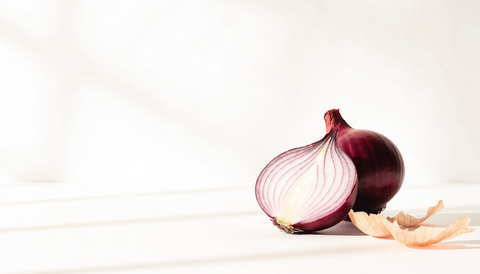
Our label says the same thing in a few words: yellow powder, insoluble in water. The yellow is not a metaphor: quercetin really is the pigment that colours the buds it is extracted from.
In the plant you do not find free quercetin,
you find quercetin with sugar
It is the sentence almost nobody writes, and everything else follows from it.
A review of quercetin bioavailability, published in Nutrients in 2019, puts it plainly: most of the quercetin in plants is bound to sugar residues, not in free form. The bound form is called a glycoside, the bare form an aglycone, and the two do not behave the same way.
The best known quercetin glycoside has its own everyday name: rutin. Chemically it is quercetin-3-O-rutinoside, meaning our molecule with a disaccharide attached at position 3. Rutin has a mass of 610.52 g/mol, compared with 302.24 for quercetin. Do the division and you get the figure worth remembering: a little under half the weight of rutin, around 49%, is quercetin. The rest is sugar.
Sophora japonica buds, the source on our label, show exactly this picture. A study published in Plants in 2024 measured 255.04 mg of rutin and 14.22 mg of free quercetin per gram of dried powder in unroasted buds, that is 25.50% and 1.42%. The ratio is close to eighteen to one in favour of the sugar form.
The same study shows how the other form is obtained. When the buds are roasted, rutin falls and quercetin rises in parallel, because heating breaks the bond with the sugar and leaves the aglycone behind. Industry does the same thing, under control: it starts from the glycoside and removes the sugar.
The word “quercetin” on a label names the molecule without sugar. In the plant, almost all of it has sugar. The difference between the two is not cosmetic: it is arithmetic, and it shows up in the timeline too.
The first view splits the rutin molecule. The second shows what you find in the bud it is extracted from.
Molecular masses: 302.24 g/mol for quercetin, 610.52 g/mol for rutin. Bud composition from a study published in Plants in 2024, on unroasted buds.

The sugar decides where it is broken off,
and the two places are metres apart
A glycoside does not pass through the gut wall as it is. It has to be broken down first, and the body has two tools for that, both in the small intestine.
The first sits right on the brush border of the cells: the enzyme called lactase-phlorizin hydrolase. It cuts the sugar off the glycoside on the spot, and the resulting aglycone enters the cell. The second route works the other way round: a glucose transporter carries the whole glycoside inside, and there a beta-glucosidase in the cytoplasm removes its sugar. Either way, what crosses the wall is the aglycone, not the glycoside.
Rutin does not fit this scheme. Its sugar is a disaccharide, joined by a bond for which humans have no enzyme. So the rutinoside travels the whole small intestine untouched, and only in the colon, where microbes take it over, is the sugar removed. That is the distance between one hour and nine hours, and it has nothing to do with dose. It is geography.
First, how much was absorbed. Then, and this is the point of the article, how long it took.
Absorption percentages from a study in volunteers with an ileostomy, cited in a review in Nutrients, 2019. Times to peak plasma level from Hollman et al., FEBS Letters, 1997, in nine volunteers.
Nine people, three sources,
and what stays in the blood is no longer quercetin
The study that settled the matter is short, old and missing from the top Romanian search results.
In 1997, Hollman and colleagues published in FEBS Letters results from nine people who were given, in turn, large doses of quercetin from different sources, with their plasma followed for 36 hours. Relative to onions, bioavailability from apples and from pure rutinoside was 30% in both cases. The blood peak came in under 0.7 hours for onions, at 2.5 hours for apple sauce and at 9 hours for rutinoside. Half-lives were 28 hours for onions and 23 for apples. The authors' conclusion is a single sentence: binding to glucose improves absorption from the small intestine.
Those long half-lives also lead to an observation the authors make themselves: with repeated intake, quercetin builds up in the blood. That is not a promise, it is arithmetic: the intake is daily, and the clearance takes more than a day.
The part written about least is the last one. In plasma, quercetin was detected only as metabolites. The gut wall and the liver attach glucuronic acid, sulphate or a methyl group to it before releasing it into circulation. The molecule in the capsule and the molecule circulating in the blood are not the same molecule, and any test done on pure quercetin in a laboratory dish is, strictly speaking, testing something other than what is in your veins.
One more figure, for scale. The same 2019 review gives an average quercetin intake among adults in the United States of 3.5 mg a day, from all food. A capsule with 100 mg is close to thirty times that.
Why quercetin almost always sits
next to vitamin C
The usual explanation is that they “work together”, which explains nothing. There is a chemical one, though, and it is more interesting.
A molecule that gives up an electron does not stay unchanged. Quercetin is oxidised in steps: first to an O-semiquinone, then to an O-quinone or quinone methide, written QQ in the literature. That oxidised form is reactive and binds to the thiol groups of proteins, meaning the sulphur atoms on them.
This is where vitamin C comes in. A review published in Frontiers in Immunology in 2020 states that QQ can be converted back to quercetin by electron donors such as NADH or ascorbate. The same paper makes the complementary observation: vitamin C, as D- or L-ascorbate but not as dehydroascorbate, prevented the spontaneous degradation of quercetin. And the reverse, stated just as clearly: if ascorbate or glutathione levels are insufficient, quercetin can be pushed towards the oxidised form.
So the pairing is not a bundle invented by marketing. It is bookkeeping: a molecule that, precisely because it does chemistry, ends up in a state from which something has to bring it back.
The honest part is that all of this was measured in laboratory systems, not in someone's blood after a capsule. Nobody has shown you that recycling in a human, with a number. What can be said is that the two are put together for a reason that can be written down on paper, and that reason is not “both are good for you”.
It is the same logic we unpacked for magnesium bisglycinate, where the label figure is the weight of the salt, not the metal, and for bromelain and papain, where the milligrams say nothing about how much the enzyme cuts. Every time, the big number on the box measures something other than what the reader thinks.

Where quercetin calls for
a question to your doctor
Quercetin is an ordinary part of the diet, in onions, apples and capers. The precautions are not about it, but about what sits alongside it in the same capsule.
Ask your doctor first if you are pregnant or breastfeeding, if the product is for a child, or if you are on medical treatment. Our formula contains MILK, through the bovine colostrum, so it is not suitable if you are allergic to cow's milk proteins. It also contains 4000 IU of vitamin D3 and 50 mg of zinc sulphate per daily dose, so it should not be combined with Vitamin D3 + K2 + A, which provides the same amount of vitamin D3, or with Full-beauty, which adds more zinc. Read the full list on the bottle before your first capsule.
What our label says
on the quercetin line
Quercetin is in Full-immunity, alongside six other actives. The daily dose is two capsules, with a glass of water, during a meal.
On the quercetin line: 100 mg, extracted from Sophora japonica buds, a flavonol found in red onions, apples and capers, yellow powder, insoluble in water. On the line above: 300 mg vitamin C, as calcium ascorbate, a buffered form, 375% of the nutrient reference value. Vitamin C contributes to the normal function of the immune system and to the reduction of tiredness and fatigue. Each of the seven actives has its own dose listed separately, with no proprietary blends. Made in the European Union, under good manufacturing practice, with a certificate of analysis for every batch. No added sugar, no colourings and no flavourings. A bottle holds 60 capsules, which is 30 days.
Where it fits into this article is exactly where we started: the 100 mg is the weight of the aglycone, not of a glycoside. On a label reading “100 mg rutin”, the quercetin part would be under 50 mg, and its route through the body would be different, longer by several hours. The rest of the formula, with the colostrum, selenium and vitamin D3, we broke down piece by piece in the complete product guide, and what happens to colostrum proteins during digestion we covered separately, in the article on immunoglobulin G.
The practical advice is the same as in the directions, but now it has a reason behind it. Take the capsule with a meal, not between meals: the vitamin D3 in the same formula needs the fat in food to be absorbed.
Frequently asked
questions
A flavonol, meaning a yellow plant pigment, with the formula C15H10O7 and a mass of 302.24 g/mol. Its systematic name, 3,5,7,3',4'-pentahydroxyflavone, says exactly where the five hydroxyl groups sit on the three rings. It is found in red onions, apples and capers, and the pure powder is yellow and practically insoluble in water.
It depends on which sugar is attached. In a study in volunteers with an ileostomy, absorption was 52% from fried onions, 24% from the pure aglycone and 17% from rutinoside. The glucose forms are broken down right at the wall of the small intestine, while rutinoside has to reach the colon so that the microbes there can remove its sugar.
Because a quercetin molecule that gives up an electron becomes oxidised itself, first to an O-semiquinone, then to a quinone that binds to the thiol groups of proteins. A review in Frontiers in Immunology, 2020, states that the oxidised form can be converted back to quercetin by electron donors such as NADH or ascorbate, and that vitamin C prevented the spontaneous degradation of quercetin.
No. Rutin is quercetin with a disaccharide attached at position 3, and its mass is 610.52 g/mol compared with 302.24 for quercetin, so a little under half the weight of rutin is quercetin. In Sophora japonica buds, rutin makes up 25.50% of the dried powder and free quercetin only 1.42%. The quercetin on a label is obtained by removing the sugar.







Comments (0)
There are no comments for this article. Be the first one to leave a message!