

Bromelain and papain: the milligrams on the label
don't tell you how much the enzyme cuts
Two plant enzymes, 100 mg each, written one under the other on a label. The figure in milligrams isn't useless, but on its own it says almost nothing, because an enzyme isn't measured by weight. It's measured by how much it manages to cut in a given time, and that unit has an exact laboratory definition. When someone bought twenty bromelain products and measured their activity, fifteen fell short of what their own label said.

Bromelain isn't one enzyme,
it's at least four
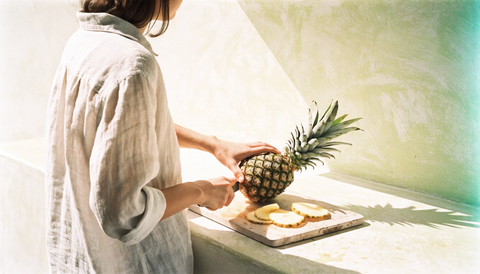
The first surprise is that bromelain isn't extracted from the part of the pineapple you eat.
In 1990, three researchers published in the Biochemical Journal the result of a careful purification of the pineapple plant, Ananas comosus. They found at least four distinct cysteine proteases. In the stem, the dominant enzyme was stem bromelain, and alongside it they isolated two enzymes that occur only there: ananain and comosain, the second being an enzyme nobody had described until then. In the fruit, the major protease was a different one, fruit bromelain.
So “bromelain” isn't the name of a molecule. It's the name of a mixture, and the mixture differs depending on which part of the plant it comes from. Industry extracts it from the stem, because that's where the concentration is high and because the stem is left over after the harvest anyway. The fruit is sold separately, by the kilo.
Papain, on the other hand, is a single enzyme, with its own number in the enzyme catalogue. It comes from the latex of the papaya fruit, and we'll get to the detail that matters there.
What each one cuts,
and why they don't cut at random
Both are cysteine proteases. The name comes from how they work: in the active site sits a sulphur atom on a cysteine, and that's what attacks the bond between two amino acids.
A protein is a long chain, and a protease doesn't dissolve it. It cuts the chain at particular places, and those places aren't chosen at random. The enzyme reads a few amino acids on either side of the bond it's about to break, and the most important position even has its own notation: P2, the second residue before the cut site.
For papain, the official definition in the enzyme catalogue is unusually precise. It hydrolyses proteins with broad specificity for peptide bonds, but with a preference for an amino acid bearing a large hydrophobic side chain at position P2. And it has one prohibition: it doesn't accept valine in the position immediately after the cut.
In plain terms: papain cuts almost any protein chain, but it stops more readily where a bulky, fatty amino acid such as phenylalanine sits nearby.
The enzymes from the pineapple stem have a different preference. A review published in 2021 describes the endopeptidases found there, stem bromelain, ananain and comosain, as cutting mainly alanyl, glycyl and leucyl bonds.
Two proteases with different preferences don't do the same thing twice. They do two different things on the same chain, and that's all the word “complementary” means when it's used correctly.
The band shows the pH range in which the enzyme works best. Press the second button to see why a plain “bromelain” on a label isn't complete information.
The bands represent ranges measured in the laboratory on purified enzyme, not a measurement of your own digestive tract. Sources: a review in Applied Sciences, 2021, for bromelain, and the technical data sheet for papain purified from papaya latex.
Why it says “with a meal”
and not “on an empty stomach”
This is where you see why the pH window isn't a laboratory detail.
The 2021 review gives stem bromelain an optimum between pH 6 and 7, with peak activity at pH 7 and 30 °C. Papain, measured as purified enzyme, also has its optimum between 6 and 7, and below pH 2.8 it loses significant activity. An empty stomach sits at around pH 1.5 to 2.
Food changes two things at once. First, it raises the pH of the stomach contents, because it dilutes and buffers the acid. Second, and this is the part people forget, food is the substrate itself. A protease with no protein around it has nothing to work on.
What can't be said, and you'll hardly find it written correctly anywhere, is how much of the 100 mg carries on further in active form. Nobody can give you that figure for your gut. What can be said is where the enzyme's window lies and where the acid that closes it begins.
We wrote at more length about what the stomach does with proteins swallowed whole in the article on bovine colostrum and immunoglobulin G, where the enzyme doing the cutting is the body's own, pepsin, and the protein being cut is an antibody.

Papain doesn't come from the ripe fruit,
it comes from the latex of the green one
Ripe, sweet papaya isn't the source. Papain is harvested from the milky latex that runs when the skin of the still green fruit is scored, then dried and purified.
The molecule that comes out of it is small and well described. Its mass, calculated from the amino acid sequence, is 23,406 daltons. It's a single polypeptide chain, with three disulphide bridges holding it tight and a sulfhydryl group on which its activity depends. The isoelectric point is reported at 8.75 and at 9.55, so the molecule is basic, unusually basic for an enzyme.
A practical detail from the data sheet explains the form in which it's sold. In solution, at neutral pH, papain loses 1 to 2% of its activity per day. It cuts itself, because it's a protease surrounded by proteases. That's why it goes into the capsule as a dry powder, not a liquid, and why activity is declared per batch, not once and for all.
Papain also needs a reducing environment to be switched on: cysteine, sulphide and sulphite activate it. In a laboratory mixture, these are added on purpose. In a capsule, they aren't.
A GDU is a definition,
not a brand
The unit bromelain is measured in is called the GDU, short for gelatin digesting unit, and its definition is short and verifiable: one GDU is the amount of enzyme that releases, after 20 minutes of digestion at 45 °C, 1 mg of amino nitrogen from a standard gelatin solution at pH 4.5.
Read it once more and notice what's there. A chosen substrate, gelatin. A fixed time, 20 minutes. A temperature, 45 °C. A pH, 4.5. And a weighed result, the amino nitrogen released. None of that describes a gut. It's a standard, just like a reference metre: it doesn't tell you how long your road is, it tells you how to compare two roads.
Papain has its own unit, and it's a different one. In a widely used definition, one unit of papain hydrolyses 1 µmol of an arginine ester per minute, at pH 6.2 and 25 °C. A different substrate, a different temperature, a different pH. A GDU and a papain unit can't be added together or compared, however much both look like figures on the same label.
The useful question, when you look at a box, isn't “how many milligrams”. It's whether the label has a line stating the activity.
In March 2023, an American supplement maker bought nineteen bromelain products from an online shop, added its own product as the twentieth, and sent the whole batch to an independent laboratory specialising in enzymes. Activity was measured in GDU, using the pharmacopoeia method for bromelain. Fifteen of the twenty fell short of the potency stated on their own label. Twelve had less than 10% of what they declared.
The test was paid for by someone who sells bromelain, and the twentieth product in the batch was theirs. That doesn't undo the method, which is a pharmacopoeia one, but it's the kind of detail that should be stated before the figure, not after.
Same batch, same pharmacopoeia method, two ways of reading the result. The second button is the surprising part.
five of twenty reached the declared potency
fifteen of twenty, or 75% of the batch
Source: the test report published in March 2023 by an American supplement maker, which bought the batch and commissioned the analyses. The twentieth product in the batch was its own.

Where the two enzymes
call for a question to your doctor
In both cases, their source is a fruit. Bromelain comes from pineapple stem, papain from papaya latex, so any product containing them carries pineapple and papaya as declared allergens. If you have a known reaction to either fruit, or to latex, read the list on the bottle before the first capsule, not after.
The second conversation isn't about the enzymes, but about what sits alongside them in the same capsule. Our formula also contains 700 mg of ashwagandha root extract, and that extract has its own precautions.
Ask your doctor first if you're pregnant or breastfeeding, if the product is for a child, if you take thyroid medication, if you have an autoimmune condition, or if you take sedatives, anticoagulants or antiplatelet drugs. The product contains pineapple and papaya as allergens, as well as 700 mg of ashwagandha root extract per daily dose. This isn't a formality in small print on the box: it's the point the decision starts from.
What our label says
on the two enzyme lines
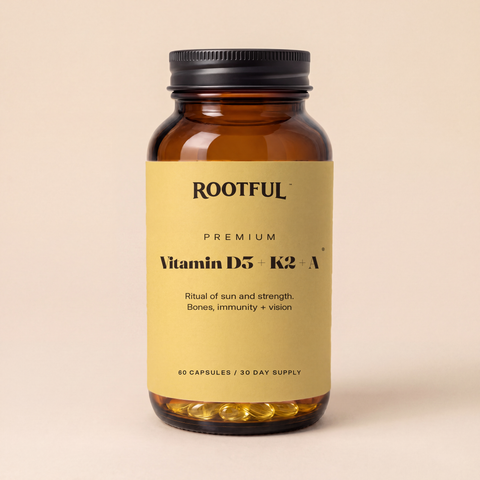
The two enzymes are in Full-gut, alongside five other actives. The daily dose is two capsules, with a glass of water, during your main meal.
On the bromelain line: 100 mg, a mixture of proteolytic enzymes extracted from pineapple stem, Ananas comosus, with activity expressed in GDU and declared on the label. On the papain line: 100 mg, a proteolytic enzyme from the latex of green papaya fruit, Carica papaya. The shell is a plant-based HPMC capsule. Each of the seven actives has its own dose written separately, with no proprietary blends. Made in the European Union, under good manufacturing practice, with a certificate of analysis for every batch. No added sugar, no colourings and no flavourings. One bottle holds 60 capsules, which is 30 days.
Where it fits with the subject of this article is simple: enzymes make sense alongside food, so the capsule is taken with a meal, not between meals and not first thing in the morning on an empty stomach. The rest of the formula, with the live cultures, the fibre and the root extract, we've taken apart piece by piece in the complete product guide.
And the practical advice that has nothing to do with us is the one from the previous chapter. On any enzyme label, look for the line with the activity unit. If there isn't one, the milligrams remain a figure about how much the powder weighs. It's the same trap as with vitamin K2 MK-7, where the figure that matters isn't the one everyone reads, and a close relative of the story of hydrolysed marine collagen, where the protein is cut in the factory before it reaches you, exactly as a protease would do it.
Frequently asked
questions
It's the unit that measures how much the enzyme cuts, not how much it weighs. The laboratory definition is exact: one GDU is the amount of enzyme that releases, after 20 minutes of digestion at 45 °C, 1 mg of amino nitrogen from a standard gelatin solution at pH 4.5. Gelatin is just the test substrate. The figure is a standard for comparing two products, not a measurement of your gut.
With a meal, for two reasons. First, food is the very substrate a protease works on. Second, their activity window is close to neutral: stem bromelain has its optimum at pH 6 to 7, papain likewise, and papain loses significant activity below pH 2.8. An empty stomach sits well below that.
They aren't the same enzyme. The pineapple plant has at least four different proteases, and in the fruit the dominant enzyme is fruit bromelain, while supplements use the stem form, the part you don't eat. The two even have different pH windows: 3 to 8 for the fruit form, 6 to 7 for the stem form.
Their source is. Bromelain is extracted from pineapple stem and papain from the latex of green papaya fruit, so a product containing them carries pineapple and papaya. If you have a known reaction to either fruit, or to latex, read the full list on the bottle before the first capsule and ask your doctor.






Comments (0)
There are no comments for this article. Be the first one to leave a message!