

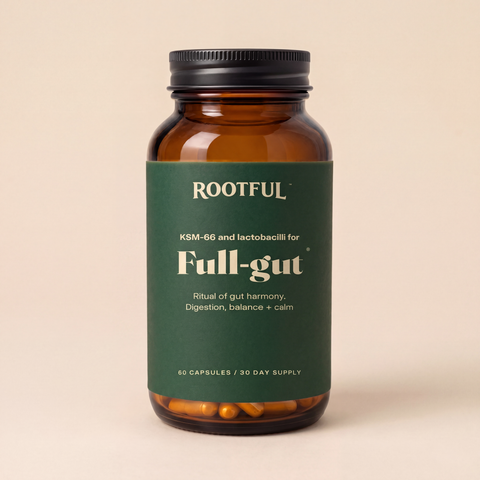
Everything you need to know about Full-gut:
the complete guide
Full-gut is a lunchtime capsule with seven actives, each with its own dose stated on the label: 700 mg KSM-66 root extract, 200 mg live Lactobacillus cultures, 100 mg each of bromelain and papain, 100 mg L-glutamine, 100 mg FOS prebiotic fibre and 10 mg piperine. This guide shows you what is in it, why it is taken with a meal and what each part does on the journey from your plate to your colon.
What is Full-gut?
It is a capsule built for one specific moment: the meal. The daily dose is two capsules, and they contain seven actives that work in different parts of the digestive tract and at different times after you have eaten.
- Seven actives, seven doses on the label. No proprietary blends and no quantities hidden behind a formula name.
- Four different categories, not four variations on the same theme. Plant enzymes, live cultures, a prebiotic fibre and a standardised root extract.
- An extract with a percentage, not root powder. 700 mg KSM-66, a patented extract of Withania somnifera, with the withanolide content measured and declared for every batch.
- No fillers. Plant-based HPMC capsule, no added sugar, no colourings, no flavourings. Made in the European Union under good manufacturing practice, with a certificate of analysis for every batch.
How to take it
Two capsules, with a glass of water, during a meal. Once a day. The meal is not a suggestion for comfort: the enzymes in the formula work on the food on your plate, so between meals they have nothing to work on. A bottle holds 60 capsules, which is exactly 30 days.

What makes Full-gut different?
- Plant enzymes, not just cultures. Bromelain from pineapple stem and papain from papaya latex, 100 mg each. Bromelain activity is expressed in GDU units and stated on the label, because milligrams alone do not tell you how active the enzyme is.
- Live cultures plus their food. 200 mg freeze-dried Lactobacillus cultures, with the colony-forming units declared, and 100 mg fructo-oligosaccharides from chicory root. The prebiotic is the part most products skip.
- 700 mg of standardised extract. KSM-66 is obtained through a solvent-free process, and the withanolide content is guaranteed at a declared value for every batch. It is the largest amount in the formula.
- L-glutamine in free form. 100 mg of an amino acid that the cells of the gut use as fuel.
- 10 mg piperine. The alkaloid from black pepper, as a standardised extract. It is the smallest amount in the formula and is listed as such, not hidden.

What happens in the gut after a meal
Digestion is not an event. It is a conveyor belt about nine metres long, which food travels along over twenty-something hours, and something different happens in each section.
In the stomach, acidity unfolds the structure of proteins. Almost all absorption takes place in the small intestine. What gets past it is, to a large extent, what your body has no enzymes to break down. Fibre, first and foremost.
And there, in the colon, a second digestion begins, one that is not yours. It is carried out by the microbiota, which works on whatever is left over. The fibres that have passed undigested through the rest of the journey are its raw material.
That is also why a serious digestive capsule cannot be a single ingredient. What helps during the meal has no business in the colon, and what feeds the bacteria in the colon does nothing on your plate. These are different moments, with different chemistry.
How Full-gut works
1. At the table: the enzymes that work on food
Bromelain and papain are proteolytic enzymes, which means they cut the bonds between the amino acids in proteins. Bromelain is a mixture of such enzymes, extracted from pineapple stem; papain comes from the latex of unripe papaya fruit. Both work during the meal itself, in the stomach and the small intestine. That is why the capsule is taken with a meal: without food, they have no substrate.
2. The journey: what has to get past the stomach
The live Lactobacillus cultures are freeze-dried, and they become active again in the digestive tract. They get past the stomach more easily when it has food in it, the second reason the timing of the meal matters. They reach the intestine within a few hours.
3. In the colon: the fibre that is not digested
Fructo-oligosaccharides are short chains of fructose, and the bonds between the units cannot be broken by human enzymes. The consequence is literal: the fibre passes through the stomach and small intestine untouched and reaches the colon intact, where bacteria ferment it into short-chain fatty acids, acetate, propionate and butyrate. Butyrate is then absorbed and used as fuel by the very cells that line the colon (a 2026 review in Nutrients describes exactly this mechanism).
4. The gut wall: fuel for the cells and background intake
L-glutamine is an amino acid in free L-form that makes up about a fifth of the entire pool of free amino acids in the blood. For the gut, it matters more than glucose as an energy source: roughly three quarters of the glutamine that reaches it enters the Krebs cycle, which means it is burned for energy (Nutrients, 2018). The KSM-66 extract and piperine fall into the category of daily intake, not an effect at mealtime.

Who is Full-gut for?
- For anyone who eats at times that change from one day to the next, with lunches eaten standing up or skipped.
- For anyone who travels often and moves from one cuisine to another, with different ingredients and a different schedule.
- For anyone who eats a protein-rich diet and wants the enzymes at exactly the meal where they matter.
- For anyone who has tried a simple probiotic and wondered why the box only talks about billions.
- For anyone who wants a single capsule at lunch instead of four bottles on the counter.
It is not reserved for anyone in particular. It is for anyone who wants their midday meal to have one part sorted as well.
Myths about digestion and probiotics
“A good probiotic settles in the gut for good”
It does not settle. A systematic review published in Frontiers in Nutrition in 2021 draws a clear distinction: being present in the gut while you are taking it is one thing, and surviving after you stop is something else entirely. For the strains followed, the microbiota returns to baseline values in the months after stopping. The practical conclusion is simple, and we also state it on the product page: the cultures remain present as long as the intake continues.
“What matters is how many billions it says on the box”
It matters, but it is a single figure in a bigger picture. The questions usually missing from the box are different ones: which species, what food comes with them and what else is in the capsule besides the cultures.
“Digestive enzymes are taken between meals”
The opposite. Proteolytic enzymes work on the proteins in food, so their moment is precisely the meal. Taken on an empty stomach, they have nothing to act on. It is the one dosing rule in this whole article that really is not worth improvising.
“A plant extract is a plant extract”
No, and here the difference is measurable. “Ashwagandha extract, 700 mg” without any percentage can mean ground root powder. Standardised means that every batch is measured and that the level of withanolides, the characteristic compounds, is guaranteed at a declared value. When you compare two labels, the percentage is the figure that matters, not the milligrams.
What to expect, week by week
The first day
Day one is about what happens at the table. Bromelain and papain start breaking down the proteins in your food during the meal itself. The live cultures get past the stomach and reach the intestine within a few hours. The FOS fibre is not touched by your enzymes and reaches the colon whole. There is nothing to feel, it is simply a day on which all four parts got where they need to be.
The first two weeks
This is where the intake becomes routine, and that is all that is asked of you. The cultures remain present for as long as you continue, no longer. In the colon, bacteria ferment the fibre and produce the short-chain fatty acids we talked about. The KSM-66 extract works through daily intake, not occasional doses.
Eight weeks
The complete cycle. The gut lining renews itself every few days, and the balance of the flora shifts on a scale of weeks, not meals. Eight weeks is the interval in which all these rhythms have had time to overlap. What you see at the end of it is a daily habit that has been kept up, not a change from one day to the next.

How to get the most out of Full-gut
- Tie it to the same meal, every day. Lunch is the natural hook, because it is the midday meal and the one most likely to contain protein. A daily habit attached to something you do anyway keeps itself going.
- Do not take it on an empty stomach. It is the only dosing mistake that really changes what you get: without food, the enzymes have no substrate, and the cultures have a harder time getting past the stomach.
- Give it weeks, not days. The fibre, the glutamine and the root extract work through repeated intake. One week tells you nothing about what eight will do.
- Keep the morning and evening free. If you want to cover the whole day, Full-immunity fits at breakfast and Full-calm an hour before bed.
How to combine it with other ROOTFUL products
The complete daily ritual. Full-immunity in the morning, with breakfast, Full-gut at lunch, with your midday meal, and Full-calm in the evening, 30 to 60 minutes before bed. The three do not double up on any mineral or vitamin.
Lunch plus your beauty routine. Full-beauty and Full-gut do not overlap on any active, so they can be taken on the same day.
Lunch plus vitamin D. Vitamin D3 + K2 + A is taken in the morning, with a meal that contains some fat, and Full-gut stays at lunch. If you choose this option, do not also add Full-immunity on the same day: each of the two provides 4,000 IU of vitamin D3, and together you would go past double the daily limit.
Before you start, and it matters more here than with other capsules. Full-gut contains 700 mg of ashwagandha root extract, something you would not expect to find in a digestive product. During pregnancy and breastfeeding, ask your doctor for advice before taking it. Not intended for children. If you have a thyroid or autoimmune condition, or if you take sedative, thyroid or anticoagulant medication, talk to your doctor first: bromelain also has known interactions with anticoagulants. Do not exceed the daily dose of two capsules, and do not combine it with another supplement containing ashwagandha. You can read more about the plant in ashwagandha in pregnancy.

Frequently asked questions
All seven actives, with the source, dose and form of each, are on the Full-gut page. This guide is the third in a series about each product in the capsule range; the first two are the Full-immunity guide and the Full-calm guide.







Comments (0)
There are no comments for this article. Be the first one to leave a message!