

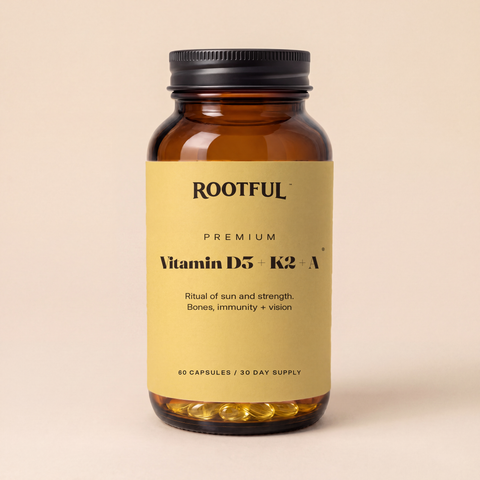
Everything you need to know about Vitamin D3 + K2 + A:
the complete guide
Vitamin D3 + K2 + A is a softgel taken with a meal, with three fat-soluble vitamins and the dose of each stated on the label: 4,000 IU vitamin D3 from lanolin, 240 µg vitamin K2 as MK-7 and 800 µg vitamin A. This guide shows you what is in it, why the three are taken in the same swallow and why the meal matters more than the time of day.
What is Vitamin D3 + K2 + A?
It is a capsule for three vitamins that travel the same way and go to different destinations. They are not together for marketing reasons, but because they are absorbed the same way: with fat, at the same meal. The daily dose is two capsules.
- Three vitamins, three doses on the label. 4,000 IU vitamin D3, 240 µg vitamin K2 and 800 µg vitamin A, with no proprietary blends.
- Vitamins D and K contribute to the maintenance of normal bones. Vitamin D also contributes to the normal absorption and utilisation of calcium, and to the maintenance of normal muscle function.
- Vitamins D and A contribute to the normal function of the immune system. Vitamin A also contributes to the maintenance of normal vision, normal skin and normal mucous membranes.
- Already dissolved in oil. Not a pressed tablet, but a softgel in which the vitamins are already in the fat phase. Made in the European Union under good manufacturing practice.
How to take it
Two capsules, with a glass of water, during your main meal. Once a day. The meal is not a recommendation for stomach comfort: without fat on your plate, part of what you swallowed goes nowhere. A bottle holds 60 capsules, which is exactly 30 days.

What makes Vitamin D3 + K2 + A different?
- 4,000 IU of vitamin D3, which is 2,000% of the nutrient reference value. A typical vitamin D capsule usually stops much lower.
- Cholecalciferol from lanolin, not ergocalciferol. It is the very form your skin makes in the sun, and the body uses it more efficiently than the D2 form.
- K2 as all-trans MK-7, 240 µg. Not “vitamin K” in general. MK-7 is the menaquinone with the longest half-life in the family: days, not one or two hours as with K1. That means a steadier level between doses.
- Vitamin A in active form, plus a precursor. Retinyl palmitate, alongside beta-carotene, which the body converts as needed. Most combinations on the market stop at D3 and K2.
- Amber glass with an aluminium cap. Vitamins A and D are sensitive to light, and a clear plastic tub leaves them exposed on the shelf.

Why vitamins D, K2 and A work together
Their common denominator is not a function, but a physical property. All three are fat-soluble: they dissolve in fat, not in water. Almost everything that follows comes from that.
The first consequence is on the way in. A fat-soluble vitamin needs bile salts to be absorbed, and absorption takes place mainly in the duodenum. Bile salts are released when the body sees fat. Without a meal, what is missing is the key, not the dose.
The second is on the way out. Water-soluble vitamins pass through the body quickly and are excreted. These do not. They are stored, released slowly and they add up if you take them from several sources at once. That is why the daily dose is a number to read carefully.
The third explains why one capsule rather than three bottles: they come in through the same door, at the same meal.
How Vitamin D3 + K2 + A works
1. At the table: where it is decided how much gets in
The softgel reaches the small intestine, where the shell gives way and the contents, already oily, mix with the fat from your food. Bile emulsifies the mixture, and the vitamins move into micelles, the tiny droplets that carry them to the wall of the duodenum. It is the only step you control, through what is on your plate.
2. In the liver and kidneys: vitamin D's two stops
The cholecalciferol you swallow is not yet active. The liver first converts it into the storage form, the one measured in blood tests. Only the second conversion, in the renal tubule, produces the active molecule. Two compulsory stops, in that order.
The difference in pace between the two forms explains the rest. The storage form has a half-life of two to three weeks. The active form, four to eight hours. One is the reservoir, the other is the tap.
3. In the bone: the proteins vitamin K2 switches on
Vitamin K does not go into the bone. It switches on an enzyme that performs a single chemical operation: it converts certain glutamate residues in certain proteins into carboxylated glutamate. It seems like nothing, and it is not, because these very groups are the ones that coordinate calcium.
Osteocalcin, the best-known bone protein in the family, has three such residues, and each binds one calcium atom in hydroxyapatite. Without vitamin K, the enzyme has nothing to work with. Vitamin K contributes to the maintenance of normal bones, and this is the mechanics behind that sentence.
4. In storage: the vitamin A waiting in the liver
Vitamin A goes elsewhere. Part of it reaches the stellate cells of the liver, where it is converted into retinyl esters, the form in which it is stored. From there it leaves bound to a transport protein, which takes it to the cells that need it.
At the end of the route, in the retina, one of its forms bends under the action of light and triggers the chain that sends the image along the optic nerve to the brain. Vitamin A contributes to the maintenance of normal vision. The beta-carotene in the formula is the alternative route: the body converts it depending on the amount, on existing stores and on the fat in the diet.

Who is Vitamin D3 + K2 + A for?
- For anyone who spends the day indoors. Office, long hours, the commute made early in the morning and late in the evening.
- For the months when the sun no longer helps. In Romania, the window in which the skin can actually produce cholecalciferol narrows a great deal from autumn to spring.
- For anyone already taking plain vitamin D. This formula adds K2 and A without a second bottle and without a second time to remember.
- For anyone thinking about their bones in the long term. After 50, the question is no longer whether to look after them, but since when.
- For anyone who eats at regular times. It fits naturally into a routine built around meals, because it depends on the meal.
If you do not recognise yourself in any of these, that is fine. This is one of those supplements that clearly suits a particular way of living through the year.
Myths about vitamins D, K2 and A
“I stock up in summer and get by on my reserves in winter”
Half true, and the wrong half is the one that matters. The reserve does exist, but the storage form of vitamin D has a half-life of two to three weeks. On the scale of a Romanian winter, an August reserve is not a plan.
“K2 is in there to make it sound complicated”
Myth. Vitamin K is the cofactor of the enzyme that carboxylates the proteins that depend on it, osteocalcin among them. Without this step, the protein stays in the form that does not coordinate calcium. It is not a label ingredient, it is a part of a mechanism.
“Supplements are taken in the morning, on an empty stomach”
For fat-soluble vitamins, it is exactly the opposite. Their absorption requires bile salts, and an empty stomach is precisely when bile has no reason to be released. The time of day matters much less than the meal.
“If it is good, more is better”
Not with vitamins that are stored. Water-soluble ones forgive an excess, because they are excreted. These add up. That is why the daily dose is written as a total, and why Vitamin D3 + K2 + A is not taken with Full-immunity, which also provides 4,000 IU of vitamin D3, or with Full-beauty, which also provides vitamin A.
What to expect, week by week
Week 1: the reservoir starts to fill
Nothing spectacular happens in the first week, and that is a good sign. Two capsules a day, with your main meal, means an intake that comes in evenly, with no peaks. The liver converts cholecalciferol into the storage form, and the store rises slowly, because that is how a molecule with a half-life of weeks rises. Your part is just one thing: do not skip the meal.
Week 4: the formula works through daily intake
After a month, the intake has become a habit and your level no longer depends on yesterday. This is where the two vitamins with a declared role in this area come in: vitamin D contributes to the normal function of the immune system, and vitamin A to the maintenance of normal mucous membranes and to normal iron metabolism.
Week 8: bones, muscles and vision
Bone works on a long clock, of months and years. What can be said at eight weeks is that you have created the conditions: vitamins D and K contribute to the maintenance of normal bones, vitamin D to the maintenance of normal muscle function and to the normal absorption of calcium, and vitamin A to the maintenance of normal vision. From here on, the only variable left is the rhythm.

How to get the most out of Vitamin D3 + K2 + A
- Tie it to a meal, not a time. Lunch or dinner, whichever is your more substantial meal. If you eat on the run in the morning, that is not the right meal.
- Make sure the meal contains fat. A little olive oil, avocado, an egg, cheese, fish, nuts. You do not need much, you need something.
- Keep it in the dark. A cupboard, not a windowsill. The amber glass does half the job, the place you keep it does the other half.
- Read the labels of the other supplements you take. Vitamin D and vitamin A add up without you noticing, especially if you also have a multivitamin in the drawer.
How to combine it with other ROOTFUL products
With Full-gut, at lunch. Full-gut is also taken during a meal, so the two can go down in the same swallow. They do not double up on any active.
With Full-calm, in the evening. Here the times separate. Vitamin D3 + K2 + A stays at lunch or dinner, and Full-calm is taken thirty to sixty minutes before bed.
What does not combine. Neither with Full-immunity, because both provide 4,000 IU of vitamin D3, nor with Full-beauty, because both provide vitamin A. Choose one, not both.

Before you start. The daily dose provides 4,000 IU of vitamin D3 and 800 µg of vitamin A, amounts that easily add up without you meaning to: do not add a second supplement with vitamin D or vitamin A, and do not combine it with Full-immunity or Full-beauty. If you are on anticoagulant treatment, talk to your doctor before starting, because vitamin K acts directly on the mechanism the medicine relies on. During pregnancy and breastfeeding, ask your doctor for advice: vitamin A in the form of retinol has its own rules during this period. Not intended for children. If you are on any other treatment or have a kidney condition, talk to your doctor or pharmacist first. Do not exceed the daily dose of two capsules.
Frequently asked questions
All three vitamins, with the source, dose and form of each, are on the Vitamin D3 + K2 + A page. This guide is the fifth and final one in the series; the other four are the Full-immunity guide, the Full-calm guide, the Full-gut guide and the Full-beauty guide.







Comments (0)
There are no comments for this article. Be the first one to leave a message!